Updated — Corrected Mobile Connector inclusion and safety guidance against Tesla UK and Electrical Safety First; removed an unsupported testing claim.
Can You Charge a Tesla From a 3-Pin Plug? UK Guide
Explainer
Granny-charging a Tesla from a UK 3-pin socket: speeds, safety rules, when it works, and when to upgrade to a wallbox.
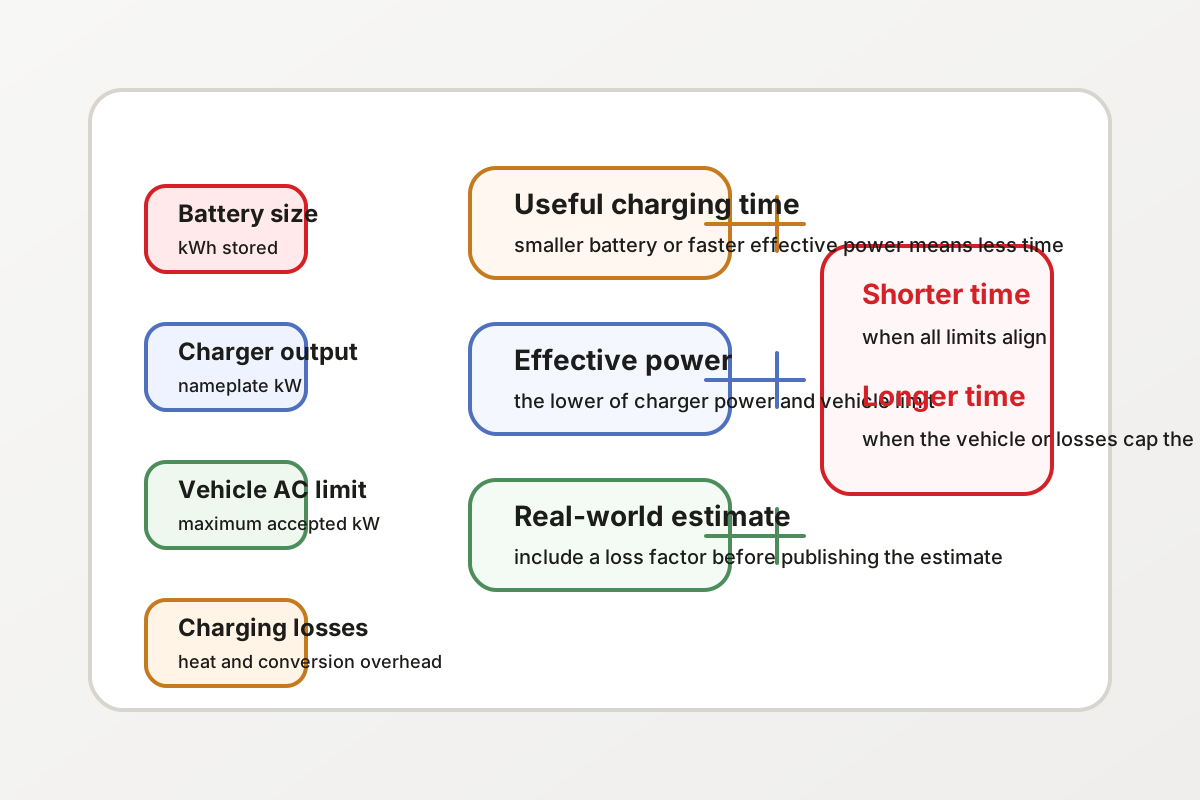
Charging time is capped by the vehicle's AC limit and the real-world losses in the charging path, not just the charger nameplate rating.
Source: Tesla vehicle charging guidance and UK home-charging calculation conventions
The Short Answer: Yes, But It's Very Slow
You can charge a UK Tesla with a compatible Mobile Connector and UK three-pin adapter, but only from a suitable, properly earthed supply. A socket that looks sound is not proof that its circuit can support a sustained EV load.
Tesla lists its UK Mobile Connector adapter at 10A / 2.3kW. Range added and charging time depend on the model, battery temperature, starting charge and losses. Treat the estimates below as planning figures, not measured results or a guaranteed overnight top-up.
Do not assume a Mobile Connector is supplied with your car. Check your order or the equipment supplied with a used Tesla before buying another; Tesla offers the Mobile Connector separately. The adapter included in a Mobile Connector bundle is not the same as a bundle being included with every vehicle.
If you do need a backup or replacement, use our portable granny-charger shortlist to compare the existing UK listings by current limit, cable reach and manufacturer support. Read the safety checks below first; a new lead does not make an unsuitable socket safe.
How Slow Is 3-Pin Charging?
Here's how a standard 3-pin plug compares to a dedicated home charger across the current Tesla range:
| **3-Pin Plug (2.3kW)** | **Home Charger (7kW)** | **Three-Phase (11kW)** | |
|---|---|---|---|
| Model 3 | ~22 hours (20-80%) | ~7 hours | ~4.5 hours |
| Model Y | ~23 hours (20-80%) | ~7.5 hours | ~5 hours |
| Model S | ~26 hours (20-80%) | ~8.5 hours | ~5.5 hours |
| Model X | ~26 hours (20-80%) | ~8.5 hours | ~5.5 hours |
| 30-mile top-up | ~3.5 hours | ~1 hour | ~40 minutes |
A typical 30-mile daily commute needs around 3.5 hours on a 3-pin plug. Manageable if you plug in every evening, but there's no margin for longer days, weekend trips, or an evening you forget.
A dedicated 7kW charger does the same top-up in about an hour. Over a full overnight window, 7kW adds roughly 175 miles against 65 miles from a 3-pin plug.
Is It Safe to Charge from a Plug Socket?
Suitability needs checking before you plug in. Electrical Safety First recommends a dedicated EV charge point and warns that sustained EV charging can exceed what standard sockets and wiring are designed for. Its guidance identifies more robust BS1363/EV sockets supplied by dedicated circuits. Ask a registered, EV-qualified electrician to check the socket, circuit and protective devices.
- Use a dedicated socket on its own circuit — don't share it with other high-draw appliances
- Never use an extension lead, multi-socket adapter or conversion plug with the Mobile Connector — Tesla expressly prohibits them
- Check the socket is in good condition — no scorch marks, cracked faceplates, or loose fittings
- Use compatible equipment with traceable manufacturer instructions — a brand name or marketplace star rating is not safety evidence
The Tesla Gen 2 Mobile Connector manual describes temperature-related current reduction and ground-fault indications. These protections do not make an unsuitable socket safe. Stop using damaged equipment and follow the manual's fault instructions.
A dedicated home charge point is the safer long-term route recommended by Electrical Safety First. The installer must specify the circuit, earthing and protective devices for the chosen charger and property; there is no single RCD prescription that fits every installation.
When 3-Pin Charging Makes Sense
There are good use cases for 3-pin charging:
- Waiting for your home charger to be installed — it bridges the gap between collecting your Tesla and getting a proper charger fitted
- Visiting friends or family — only with permission and an assessed, suitable supply; plan around the car's charging estimate
- Very low mileage drivers — if you drive under 20 miles a day, a 3-pin plug can keep up
- Backup if your main charger fails — where a separate suitable supply is available
For storage and cable organisation, see our EV charging accessories guide. A bag or cover is not a substitute for suitable electrical equipment, and must not obstruct ventilation or conflict with the manufacturer's instructions during use.
What Is a Granny Charger?
A granny charger is the informal name for a portable Mode 2 EVSE with a domestic plug. The nickname does not mean that any domestic socket is suitable.
Tesla’s version is the Mobile Connector (also called the UMC — Universal Mobile Connector). Other manufacturers sell similar portable EVSEs. One end goes in the wall socket, the other into the car’s Type 2 port; charging begins at ~2.3 kW.
Key specs:
- Power: Tesla UK adapter: 10A / 2.3kW at 230V; third-party models have their own limits
- Speed: ~8 miles of range per hour
- Connector: Type 2 (car end), 3-pin plug (wall end)
- Safety: Check the exact model's manual and conformity documentation; do not assume all portable leads have the same protections
Granny Charger Safety: The Non-Negotiable Rules
These checks do not replace an electrical assessment or the instructions for your exact equipment:
1. Never Use an Extension Lead
Tesla's manual prohibits extension leads, multi-outlet adapters, multi-plugs, conversion plugs and power strips. Plug the correct Tesla adapter directly into a suitable socket. Do not buy a generic adapter or extension to make an unsuitable setup reach the car.
2. Use a Dedicated Socket on Its Own Circuit
Tesla specifies a dedicated, properly earthed circuit. Have an electrician assess the supply rather than assuming a spare socket or a spur is suitable. If using a twin socket, Tesla says not to plug anything into the other outlet.
3. Check the Socket Condition
Before regular use, inspect the socket for:
- Scorch marks or discolouration
- Cracked or loose faceplates
- Loose fittings (the plug shouldn’t wobble)
- Any burning smell during charging
A socket in poor condition can overheat under sustained load. If in doubt, get an electrician to check it.
4. Check the Exact Cable and Adapter
Use the correct UK adapter for your Mobile Connector, or a compatible portable EVSE from a reputable retailer with accessible manufacturer instructions. Confirm its current limits, conformity information and UK support route. Never assume every branded cable has temperature monitoring or the same fault protection.
5. Have the Protection Specified
Ask the electrician to check earthing and the required protective devices, not just the socket faceplate. For regular home use, discuss a dedicated EV charge point. A plug-in accessory cannot turn an unsuitable circuit into an approved charging installation.
When Granny Charging Makes Sense
There are good use cases for granny charging beyond the emergency backup scenario:
Holiday Homes and Second Properties
If you have a holiday cottage or second home, installing a full wallbox may not be justified for occasional visits. A granny charger tops you up overnight during your stay.
Visiting Friends or Family
Ask permission and confirm the supply is suitable before you travel. Do not rely on an unassessed spare socket or promise yourself a fixed amount of range by morning; keep a public-charging alternative available.
Temporary Accommodation
Renting short-term or in temporary housing where you can’t install a wallbox? Granny charging bridges the gap.
Very Low Mileage Drivers
If you drive under 15–20 miles per day, a granny charger can technically keep up. But you’re still missing out on off-peak tariff savings that a smart wallbox enables.
Upgrade Path: Granny Charger vs Wallbox
Cost and benefit, side by side:
| Factor | Granny Charger (3-pin) | Wallbox (7 kW) |
|---|---|---|
| Upfront cost | Check whether you already own a compatible lead; otherwise budget for one and any electrical work | £800–1,200 installed planning range |
| Charging speed | 8 miles/hour | 25–30 miles/hour |
| Off-peak tariff benefit | Limited (slow charging = narrow window) | Full benefit (charge fully in off-peak window) |
| Annual electricity cost* | ~£746 (standard tariff) | ~£229 (off-peak tariff) |
| Safety | Requires suitable equipment and an assessed supply | Purpose-built, professionally specified circuit |
| Smart features | None | Scheduling, tariff integration, solar diverting |
*Based on 10,000 miles/year. The wallbox enables off-peak charging at 8p/kWh vs standard 26.11p/kWh.
The £517/year saving from switching to off-peak tariff charging means a wallbox pays for itself in about two years — and keeps saving you money every year after that.
When You Should Upgrade to a Dedicated Charger
For most Tesla owners, the answer is as soon as possible. You should seriously consider upgrading if:
- You drive more than 30 miles per day — a 3-pin plug barely keeps pace, and one busy day puts you behind
- You want to use off-peak electricity tariffs — the savings case. Most EV tariffs offer cheap rates during a 4-6 hour overnight window. On a 3-pin plug, that window gets you roughly 40 miles. On a 7kW charger, up to 175 miles — the difference between a small saving and hundreds of pounds a year
- You want smart features — charge scheduling, solar diverting, energy tracking, and integration with your EV tariff all require a proper smart charger
Switching to an off-peak EV tariff makes a dedicated charger even more worthwhile — you could charge at 8p/kWh overnight instead of the standard rate. To see exactly how much you'd save, try our interactive charging cost calculator.
The maths make a strong case. A home charger costs £800-1,200 fully installed. If you switch to an off-peak EV tariff and charge at 8p/kWh instead of 26.11p/kWh, you save £517 a year at a typical 10,000-mile annual mileage. Against the standard rate alone the charger pays for itself in 18-28 months; against Supercharging, in under a year and a half.
Next: Compare home chargers | Get free installation quotes
What Does a Dedicated Home Charger Cost?
A quick breakdown:
- Charger unit: £475-625 for the most popular models (Easee, Ohme, Hypervolt, Tesla Wall Connector)
- Standard installation: £400-600 depending on cable run length and your consumer unit
- Total: £800-1,200 for most homes
If you're a renter or flat owner, the OZEV grant knocks £500 off the installation cost, bringing the total closer to £300-700.
For a full breakdown of the most affordable options, see our cheapest EV charger guide.
The Bottom Line
Charging your Tesla from a 3-pin plug works, and it's a perfectly reasonable short-term solution. But it's roughly 3x slower than even a basic dedicated home charger, and it locks you out of the biggest savings available to EV owners — cheap off-peak electricity.
For most Tesla owners, a home charger earns back its cost within a year. It charges faster, costs less per mile, and is purpose-built for the job.
Next steps:
FAQ
Frequently asked questions.
Your next useful step: compare any two chargers head to head.