Updated — Charging-time and tariff modules refreshed
Tesla Model 3 Home Charging UK: Costs, Speeds, Best Chargers
Vehicle guide
Charge a Model 3 in 5 hours on a 7 kW wallbox; from £4 on an off-peak tariff. UK charge times by variant, real costs, and the right home charger.
Battery
82 kWh
20–80% at home
~7h 10m
AC limit
11 kW
20–80% at 8p
£3.94
Range
~320 mi
Charging time estimates
Approximate AC charging times
| Charge window | 3-pin (~2.3kW) | 7kW | 11kW max |
|---|---|---|---|
| 20–80% | 23h 5m | 7h 35m | 4h 50m |
| 0–100% | 38h 30m | 12h 40m | 8h 5m |
Assumes 8% charging losses and rounded 5-minute estimates. 3-pin assumes about 2.3kW; 7kW uses up to 7kW; three-phase only appears when the vehicle can accept more than 7.4kW AC.
Vehicle-specific tariff cost
Tesla Model 3 Long Range charging cost at 10,000 miles.
EV electricity only, using 3.5 miles per kWh and assuming every charging kWh reaches the listed lower rate. Household electricity and the postcode-dependent standing charge sit outside these figures.
Compare the full household bill, eligibility and achievable off-peak share in the EV tariff decision guide.
Charger picks
Tesla Model 3 Long Range: 3 chargers we’d pick
Picked for the trade-offs that matter most when you’re buying for Tesla Model 3 Long Range specifically.

Best fit for Tesla Model 3 Long Range
Tesla Tesla Wall Connector (Gen 3)Native Tesla-app integration surfaces charging sessions directly on the car's display; no third-party charger matches that, and at £475 it remains the lowest-priced unit in this selection.
- Price
- £475
- Power
- 7.4kW / 22kW

Direct API to Octopus Intelligent Go and Agile books the cheapest overnight slots without manual scheduling; 82 kWh at 11 kW fills in roughly seven and a half hours.
- Price
- £539
- Power
- 7.4kW

Three-phase output delivers the full 11 kW AC rate the Model 3 LR accepts; at the smallest footprint that achieves it, the Pulsar Max adds a five-year warranty.
- Price
- £513
- Power
- 7.4kW / 22kW
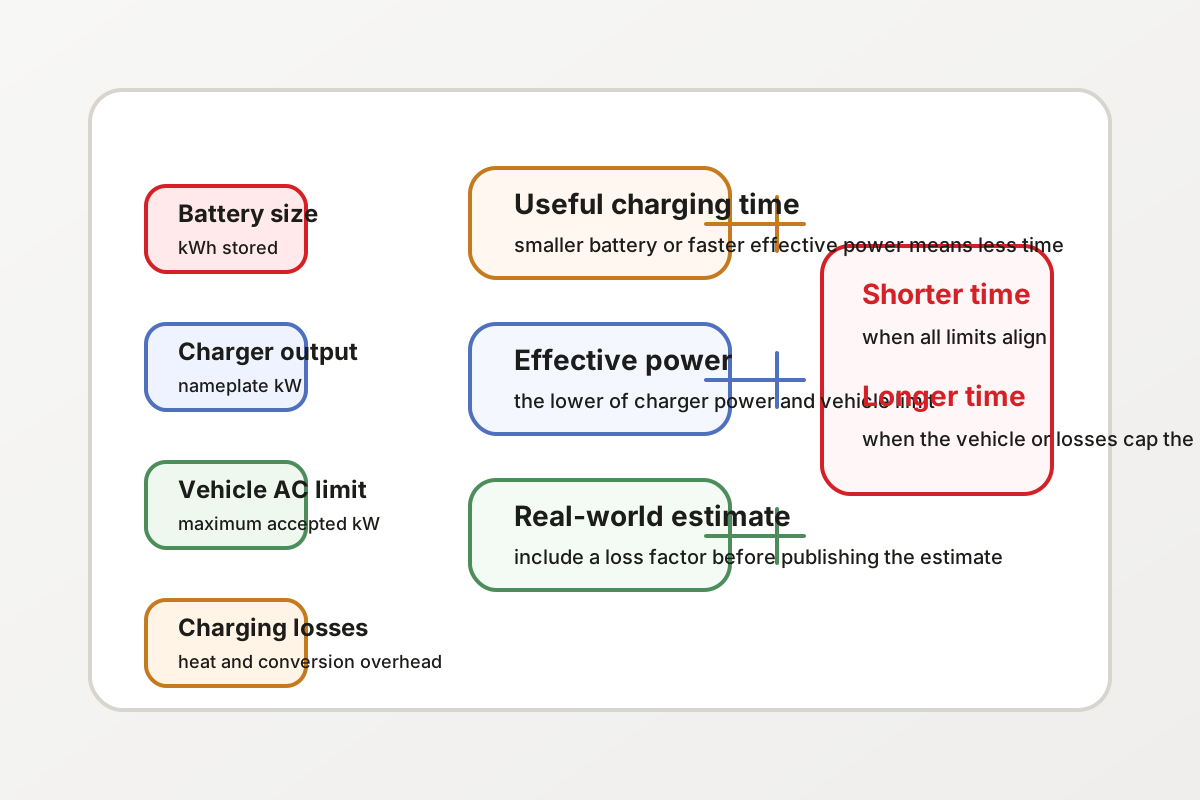
Charging time is capped by the vehicle's AC limit and the real-world losses in the charging path, not just the charger nameplate rating.
Source: Tesla vehicle charging guidance and UK home-charging calculation conventions
The hardware
A 7 kW wallbox covers every Model 3 sold in the UK. The Standard Range is capped at 7.4 kW on AC anyway — exactly what a single-phase supply delivers; the Long Range and Performance can accept 11 kW on three-phase, which 95% of UK homes can't supply. The car is one of the most efficient saloons on the road, and the charging side reflects that: there's not much to overthink.
Variants (2026)
| Variant | Battery | Max AC | Max DC | WLTP range |
|---|---|---|---|---|
| Standard Range (RWD) | 60 kWh | 7.4 kW (single-phase) | 170 kW | 272 miles |
| Long Range (AWD) | 75 kWh | 11 kW (three-phase) | 250 kW | 391 miles |
| Performance (AWD) | 75 kWh | 11 kW (three-phase) | 250 kW | 365 miles |
7.4 kW for the Standard Range, 11 kW only if you happen to have three-phase. Most UK owners charge at 7 regardless of variant. For home charging, that means the Standard Range should not be paired with a three-phase box you cannot use. For tariffs, the cleanest route is an EV tariff such as Octopus Intelligent Go when you want automatic off-peak charging, or a solar-aware unit like the Zappi GLO when you want daytime surplus to do the work. The recommended charger path is Tesla Wall Connector for the longest cable and native app control; Ohme Home Pro for tariff automation; Easee One if you want the most compact grant-eligible option.
How long it takes to charge a Model 3
20% to 80% — the everyday window
| Variant | 3 kW (3-pin) | 7 kW (wallbox) | 11 kW (three-phase) |
|---|---|---|---|
| Standard Range (60 kWh) | ~12 hours | ~5 hours | ~5 hours |
| Long Range (75 kWh) | ~15 hours | ~6.5 hours | ~4 hours |
| Performance (75 kWh) | ~15 hours | ~6.5 hours | ~4 hours |
The Standard Range tops out at 7.4 kW on AC, so three-phase makes no difference for that variant.
0% to 100%
| Variant | 3 kW (3-pin) | 7 kW (wallbox) | 11 kW (three-phase) |
|---|---|---|---|
| Standard Range (60 kWh) | ~20 hours | ~8.5 hours | ~8.5 hours |
| Long Range (75 kWh) | ~25 hours | ~10.5 hours | ~7 hours |
| Performance (75 kWh) | ~25 hours | ~10.5 hours | ~7 hours |
Plug in at 10pm on a 7 kW wallbox and the car is full by morning. For a 30–50-mile commute, an hour or two each night is enough. A 3-pin plug just about keeps up with a quiet week; weekends are where it loses.
What it costs to charge a Model 3 at home
The tariff does almost all the work. The Model 3 manages around 3.9 miles per kWh in real UK driving, winter included — among the most efficient cars sold in the country.
Cost per charge, 20% to 80%
| Variant | Off-peak (8p/kWh) | Standard (26.11p/kWh) | Supercharger (~40p/kWh) |
|---|---|---|---|
| Standard Range (36 kWh) | £2.88 | £9.40 | £14.40 |
| Long Range (45 kWh) | £3.60 | £11.75 | £18.00 |
| Performance (45 kWh) | £3.60 | £11.75 | £18.00 |
Cost per full charge
| Variant | Off-peak (8p/kWh) | Standard (26.11p/kWh) | Supercharger (~40p/kWh) |
|---|---|---|---|
| Standard Range (60 kWh) | £4.80 | £15.67 | £24.00 |
| Long Range (75 kWh) | £6.00 | £19.58 | £30.00 |
| Performance (75 kWh) | £6.00 | £19.58 | £30.00 |
Annual cost at 10,000 miles
| Tariff | Cost per mile | Annual cost | Saving vs petrol |
|---|---|---|---|
| Off-peak (8p/kWh) | ~2.1p | £205 | £1,395 |
| Standard (26.11p/kWh) | ~6.7p | £670 | £930 |
| Supercharger (40p/kWh) | ~10.3p | £1,026 | £574 |
| Petrol equivalent | ~16p | £1,600 | — |
Based on 3.9 miles per kWh (real-world UK average, winter included). Petrol assumes 40 mpg at £1.45/litre.
The gap between standard rate and an off-peak EV tariff is worth around £465 a year on typical mileage — the single biggest lever on running costs. Picking the right charger is second. Most owners want both. The interactive savings calculator does the maths for your mileage; the UK EV Charging Cost Index sets it against every UK tariff.
Choosing a Model 3 charger
Every charger we cover pairs with the Model 3 — the Type 2 connector is universal in the UK, so you're not locked into Tesla's own hardware.
The default is the Tesla Wall Connector at £475 — cheaper than most premium-brand rivals, the longest cable in the round-up at 7.3 metres, and the app already on your phone. Power-sharing across up to six units matters if a second Tesla joins the household. It isn't OZEV-approved, so renters and flat owners lose the £500 grant; for them, the Easee One below is the like-for-like that keeps it.
For a smart tariff, the Ohme Home Pro at £539 talks directly to Octopus, OVO and British Gas. On Intelligent Go it schedules within the off-peak window without you touching it; on Agile it reads next-day prices in half-hour increments. Over a year, the automation tends to find £50–100 more than scheduling by hand. Solar diverting comes built in.
If solar's part of the picture, the Zappi GLO at £599 routes surplus into the car. The Standard Range's 60 kWh battery is small enough that a 4 kW array can fill it almost entirely from surplus on long summer days; in winter, switch to grid top-up.
For grant-eligible buyers, the Easee One at £489 is the cheapest way in — compact, reliable, with a 4G SIM included so it works where Wi-Fi doesn't reach. It's OZEV-approved, and at £489 the £500 grant covers the unit outright, which makes it the cheapest installed option here.
Full head-to-heads: Tesla vs Ohme, Tesla vs Hypervolt, and the rest on the comparison page.
Battery care
The Model 3 battery is warranted for 8 years or 100,000 miles (120,000 on Long Range and Performance) at 70% capacity retention. It will outlast most of what people worry about over a decade of ownership. Two habits do most of the work: set the daily charge limit to 80% in the Tesla app, and try to keep the car between 20% and 80% in normal use. 100% is for trips. 0% is best avoided.
DC fast charging puts more heat through the cells than overnight AC, but Tesla designed the car for it — the right balance is mostly home charging with the occasional Supercharger on long days. Going on holiday, leave it at 50–60%. Heading to a Supercharger off-route? Tap the pin on the map first so the car preconditions the pack on the way.
Heat does more damage than cold. The UK climate is gentle by global standards; in heatwaves, park in shade if you can. That's most of it.
Common questions
Can I charge a Model 3 from a 3-pin plug?
Yes. Tesla includes a Mobile Connector that plugs into a standard 3-pin socket and charges at ~2.3 kW — about 8 miles of range per hour. Fine as backup or for very low mileage; not a daily solution. Full guide to 3-pin plug charging.
Is 7 kW fast enough?
For nearly everyone, yes. At 7 kW you add ~25 miles of range per hour, so an 8–10 hour overnight session covers 200–250 miles. The only Model 3 owners who feel the limit are people doing 200+ mile days back-to-back with no margin to plug in.
Do I need a Tesla-specific charger?
No. Every UK Tesla uses a standard Type 2 connector. Any home charger with a Type 2 plug works. More on Tesla vs third-party chargers.
Is it worth upgrading to three-phase?
For nearly all Model 3 owners, no. The Standard Range can only take 7.4 kW on AC — three-phase makes no difference at all. The Long Range and Performance can take 11 kW, but 95% of UK homes are single-phase, and a £3,000–5,000+ supply upgrade isn't paid back by saving an hour or two overnight.
Getting set up
- Switch to a smart energy tariff — the savings start before the charger does
- Choose a charger that fits how you drive — compare them here
- Get installation quotes — request up to three local responses, no obligation
- Read the installation guide so the day itself is uneventful
- The new Tesla owner checklist covers everything else for the first week — from insurance to Supercharger setup
Own a Model Y instead? See our Tesla Model Y home charging guide for the equivalent breakdown.
Home charging changes the rhythm of Model 3 ownership. No petrol stations, no Supercharger queues — plug in when you get home, wake up to a full battery.
For our ranked recommendations, see the best Tesla home charger guide.
FAQ
Frequently asked questions.
Your next useful step: compare the recommended home chargers.