Updated
Home Battery and EV Charger: Should You Get Both? (UK)
Explainer
Should you pair a home battery with your EV charger? We break down the costs, benefits, and whether it makes financial sense for UK EV owners in 2026.
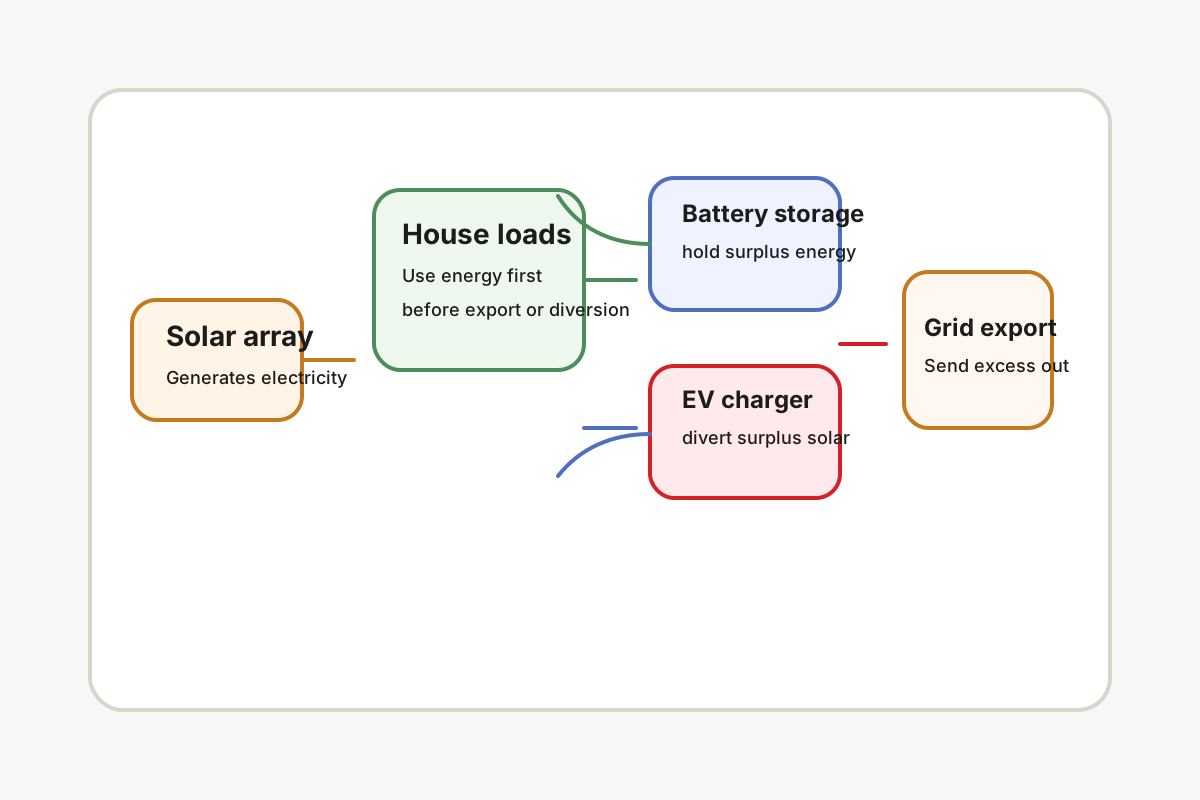
Solar charging decisions depend on whether generation is self-consumed, stored in a battery, diverted to the charger, or exported to the grid.
Home Battery and EV Charger
The short answer: a home battery paired with an EV charger makes financial sense if the house has solar, and usually doesn't if it doesn't. With solar, the battery captures generation that would otherwise be exported for pennies. Without solar, the economics come down to tariff arbitrage — and a smart EV tariff delivers most of the same savings with no upfront cost.
How they work together
Charging the EV directly from the battery
A typical home battery holds 5–13 kWh. An EV battery holds 60–100 kWh. A fully charged home battery adds roughly 15–45 miles of range — useful as a top-up, nowhere near a full charge.
The indirect, and more practical, approach
Use the battery to run the house through peak hours (4–7 pm) while the EV charges directly from the grid on the off-peak window. House and car both run on the cheapest available electricity, and the battery isn't wasting cycles on the one load the grid is already cheapest for.
The GivEnergy ecosystem
GivEnergy offers the most integrated setup. Their EV charger talks directly to GivEnergy batteries through a single app — charge from stored solar, prioritise battery or EV, monitor the whole system in one dashboard. No other manufacturer offers this depth of charger-battery integration.
Solar + battery + EV
This is where the numbers start working. A 4 kW solar array plus a 10 kWh battery plus a 7 kW EV charger can save £1,000–1,200/year against a standard setup. The battery captures solar that would otherwise export at 4–15p/kWh and discharges it at the 26.11p retail rate.
See the solar panels for EV charging guide for the full model.
Without solar: tariff arbitrage alone
Without solar, the battery has to earn its keep on the gap between off-peak and peak rates:
- Charge at 8p/kWh overnight
- Discharge at 26.11p/kWh during peak
- Save 18.1p per kWh shifted
A 10 kWh battery cycling daily produces roughly £661/year in savings. Against a battery cost of £5,000–8,000, payback lands at 8–12 years. Switching to Octopus Intelligent Go saves £517/year with zero upfront cost — most of the battery's benefit without the capital outlay.
When the pairing makes sense
Get both when:
- The house has 3 kW+ of solar
- Energy independence or backup power is part of the brief
- Octopus Agile is the target tariff and negative pricing events are actively exploited
Skip the battery when:
- No solar, no imminent plans for it
- Budget is tight — solar first, battery later
- The goal is cheap EV charging; a smart tariff gets most of the way there
Cost comparison
| Scenario | Annual Savings | Upfront Cost | Payback |
|---|---|---|---|
| EV tariff only | £517/year | £0 | Immediate |
| Solar + EV | £700/year | £5,000–7,000 | 7–10 years |
| Solar + battery + EV | £1,000–1,200/year | £10,000–17,000 | 8–14 years |
| Battery only + EV tariff | £640/year | £5,000–8,000 | 8–12 years |
V2G: the direction of travel
Vehicle-to-grid can let a supported EV take on some of the work of a home battery, but only as part of a compatible complete system. The Indra Smart PRO is a conventional one-way AC charger, not a V2H unit. See our V2G explainer for what is actually available today.
The bottom line
A home battery plus EV charger earns its keep with solar. Without solar, a smart tariff delivers most of the same savings for no capital outlay. The GivEnergy ecosystem is the most tightly integrated; the Zappi GLO is the best standalone charger for solar homes.
For the broader picture, see the solar + EV guide or the best charger for solar roundup.
FAQ
Frequently asked questions.
Your next useful step: see the ranked solar-charger guide.